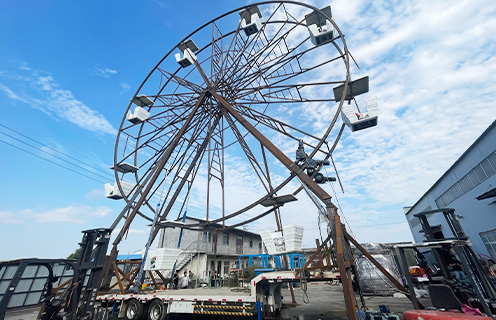
This gallery follows the whole height ladder. It starts at the 14 m mini wheel built for family parks and small plots, passes through the 20 m models —including a flower basket version and a trailer-mounted unit —then the 30 m class that covers malls, community parks and city forecourts, and ends at the 65 m and 88 m landmark machines.
Height changes the foundation, the erection method and the power arrangement before it changes the view. A 20 m wheel can be assembled with a modest crane on a prepared pad; a 65 m or 88 m structure needs a foundation designed for the wind load at that height, a staged erection programme and cabins that can be serviced at the rim. The clips show the scale difference better than any drawing.
Two models in the group are not standard park wheels: the trailer-mounted 20 m unit travels between events, and the non-electricity wheel runs without a motor, which suits sites where a power connection is the obstacle rather than the budget.
Two wheels of the same height can feel like different rides because of their cabins. Open gondolas suit warm climates and short rides; enclosed cabins with air conditioning extend the season and the ride time; themed cabins turn the wheel into part of the park's identity. The structure is the same engineering problem at every size — the cabin is what the visitor remembers.
Ferris wheel category · 30 m classic wheel · 88 m wheel · Trailer-mounted 20 m wheel
By cabin count and rotation time rather than height alone. A 20 m wheel at 48 passengers and a 30 m wheel at 96 are different businesses.
A site-designed foundation and staged installation. The 88 m and 128 m wheels are engineered per project rather than shipped as a standard kit.
Partly. Drive and support legs show at the base, and power figures run 1.1 kW on the mini wheels to 25 kW on city wheels.
CE on the models that list one, with design work to EN 13814 for EU destinations or GB 8408 for the domestic market.
Tell us the ride type, site size and target opening date. We reply within one working day.