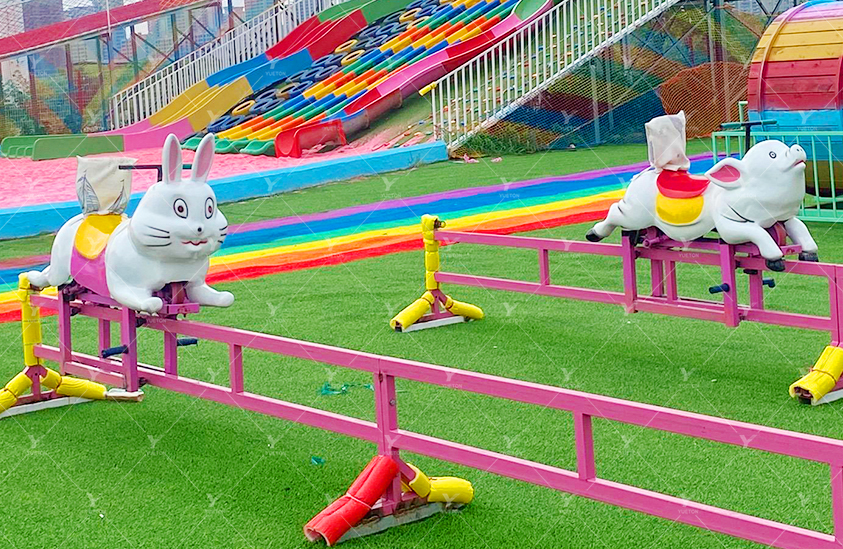
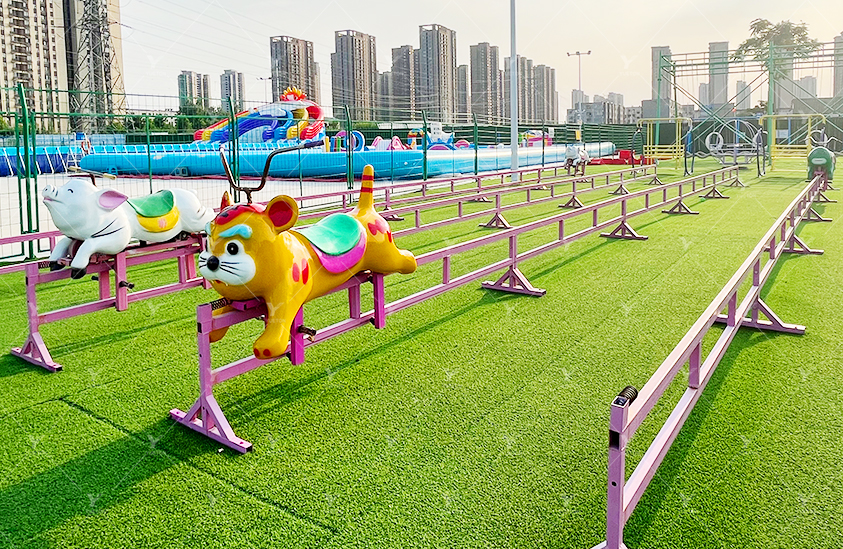
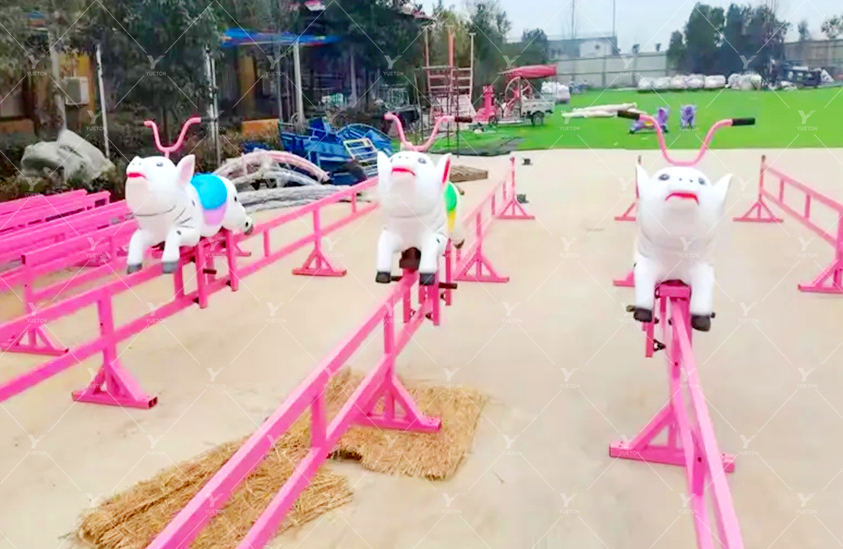
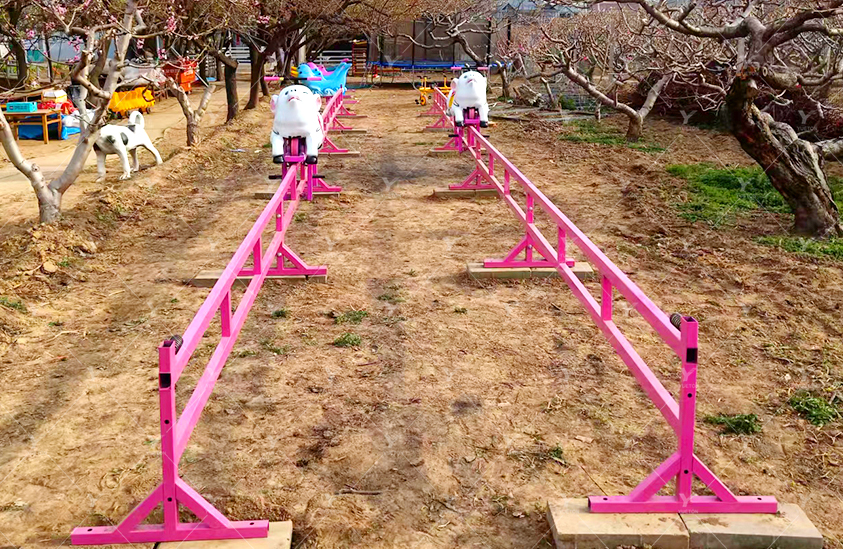
A race works because everyone grasps the rules immediately. Line up, go, first to the end wins. Children supply the effort themselves, whether by pedalling or pushing, which keeps the play active and means nothing has to be powered, charged or plugged in. Races restart on their own, with no cycle to wait for.
Track length and the number of lanes are customized, so a venue can offer a short sprint or a longer run with several racers side by side. Lanes are separated to prevent contact between riders, and the track surface is chosen for grip and durability. Both ends are arranged so ride-ons can be turned and returned without crossing the next race.
Family parks, playgrounds, kindergartens and community spaces all suit it. It usually goes where the ground is flat and sightlines are open, because part of the appeal is that parents and friends can watch the whole race. The game draws a crowd without needing a large plot, and it sits comfortably beside a family swing set or a gravity zip line when you are building a zone of active, non-powered attractions.
There is little to service. Wheels, bearings and fixings take most of the attention, along with checks on the track surface. Because no power system exists, nothing can fail electronically, and CE certification covers the ride design. A routine inspection before opening plus a periodic bearing check forms the core of the workload.
Racing runs best with a light touch. A member of staff or a parent standing at the finish end is usually enough to keep turns fair and to reset ride-ons between heats. The track layout itself helps: lanes with clear start and finish markings give children an obvious place to line up and an obvious place to stop, which reduces the arguments that appear when a game has no visible rules.
For busier periods, a simple queue line beside the start position keeps waiting riders out of the racing lane. Because nothing on the ride is powered, there is no switch to operate and no start-up sequence to supervise — the marshalling is purely social.
|
Product name |
Piggy race |
|
Model Number |
YTCN-5NP-18 |
|
Size |
Customized |
|
Packaging |
Export package |
|
Color |
Customized Color |
|
Suitable age |
Over 3 years old |
|
MOQ |
1 Set |
Riders sit on piggy ride-ons and move along their lane under their own power, pedalling or pushing. The first to reach the finish wins, and the race can be restarted straight away.
Children from around three to ten years. The ride-ons and lane widths are sized for that range, and younger children can take part with a little help from an adult.
It is customized. Venues frequently choose two to four lanes depending on available length and expected visitor numbers. We plan lane width and separation to suit your site.
No. Riders generate all the movement. That means no power supply at the ride, no running cost, and no electrical components to inspect or replace over the years.
Light. Wheels, bearings and fixings are checked regularly, and the track surface is inspected for wear. Spare parts remain available after delivery, and CE documentation is provided. Because there is no power system, the routine stays short and needs no electrical specialist.
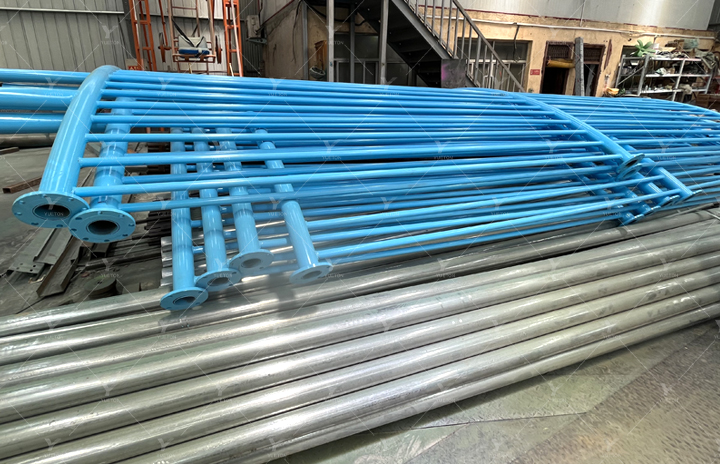
01 Production
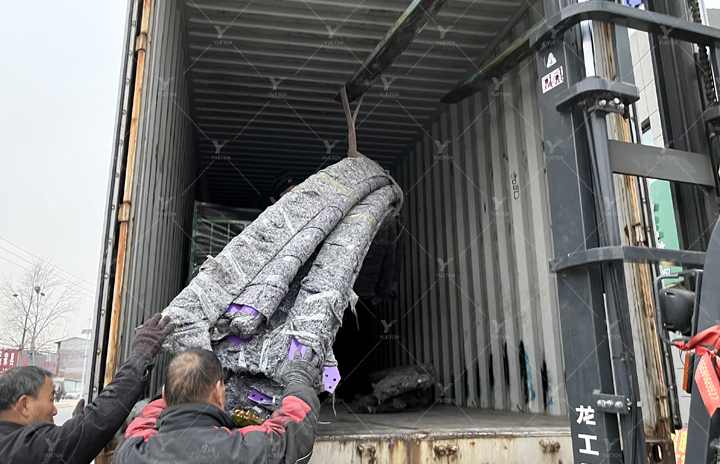
02 Shipping
03 Installation
04 Feedback
05 Application Scenario


Error: Contact form not found.