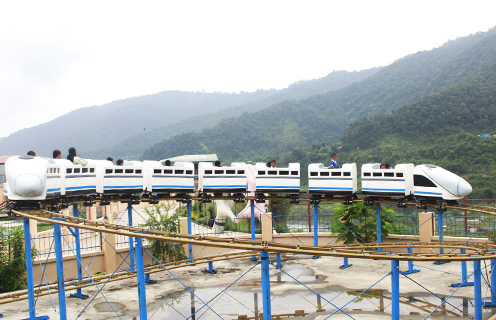
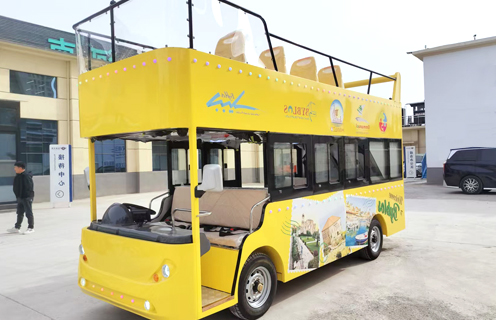
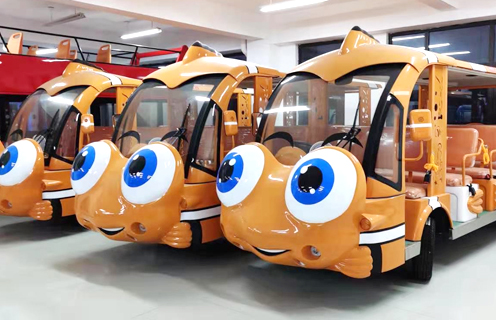
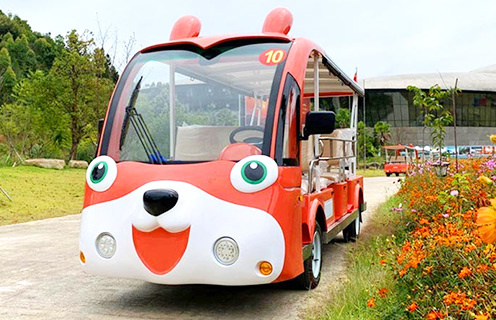
Park transport rather than a ride. These move visitors around the site, which matters once a park passes roughly 20,000 m² and walking between areas becomes a decision for the visitor.
| Model | Model No. | Capacity |
|---|---|---|
| Compact Sightseeing Bus for Parks | YTCN-5SCT-01 | 8 |
| Compact Sightseeing Bus | YTCN-5SCT-06 | 8 |
| Bright Sightseeing Bus | YTCN-5SCT-07 | 8 |
| Versatile Sightseeing Bus | YTCN-5SCT-02 | 11 |
| Mid-Size Sightseeing Bus | YTCN-5SCT-03 | 14 |
| Whale Sightseeing Bus | YTCN-5SCT-05 | 14 |
| Large Sightseeing Bus | YTCN-5SCT-08 | 22 |
An 8 to 11-seat bus is the usual starting point: it can use existing paths without widening them, and one driver handles it. From 14 seats the vehicle needs a wider turning radius, which means the route has to be planned before the bus is ordered. The 22-seat model is effectively a small train on rubber tyres and is normally used on a fixed loop with designated stops.
Tourist buses are built with road-vehicle bodies — whale, compact, bright, large — rather than train styling. That makes them read as transport, which is what a resort, a zoo or a city tour operation needs: a vehicle visitors accept as a way to get somewhere, not an attraction they queue for.
The large sightseeing bus and the train mini shuttle sit at the top of the capacity range. At that size the vehicle becomes a scheduled service with a timetable rather than a continuous ride, and the route and its dwell points matter more than boarding speed.
Tell us the ride type, site size and target opening date. We reply within one working day.