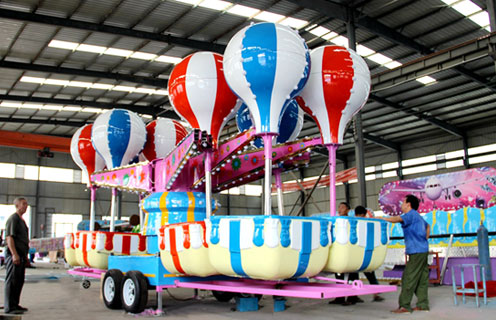
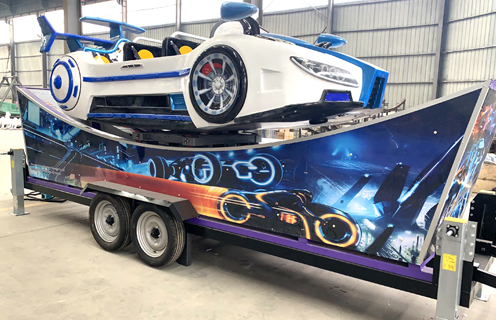
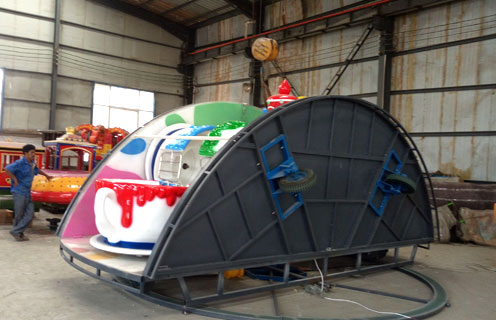
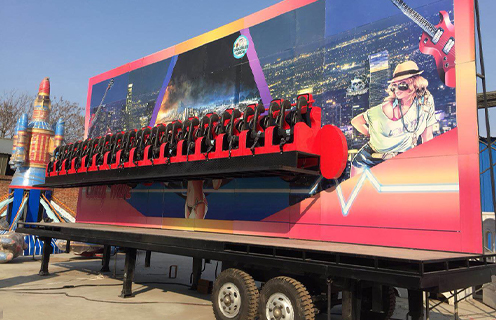
These are the rides bought by travelling operators and event companies. The difference from the standard versions is not the ride itself but the base: each is built on a trailer or a foldable frame so it can be loaded, moved and set up on a new site.
| Model | Model No. | Capacity | Power | Footprint |
|---|---|---|---|---|
| Portable Flying Car | YTCN-5PTR-06 | 8 | 3.2 kW | 6 × 9 m |
| Portable Miami Ride | YTCN-5PTR-04 | 10 | 11 kW | 6 m |
| Fordable Bumper Car | YTCN-5PTR-03 | 12 | 5.5 kW | 16 × 11.8 × 4.23 m |
| Touring Miami Ride | YTCN-5PTR-01 | 16 | 6 kW | 12 m |
| Portable Coffee Cup | YTCN-5PTR-05 | 24 | 3 kW | 6 m diameter |
| Trailer Disco Tagada | YTCN-5PTR-02 | 24 | 30 kW | 10 m |
| Portable Samba Balloon | YTCN-5PTR-07 | 32 | 11 kW | 10 m diameter |
Transport width — a trailer-mounted ride has to fit road width limits in its travelling configuration, which is why several of these list a folded dimension rather than a working one. Set-up time — the important number for an event operator is hours from arrival to running, not the ride's specification. Power — event sites often lack 380 V three-phase, so the lower-power models (3–6 kW) are the practical choice when supply cannot be guaranteed.
A portable ride is judged by how long it takes to take down and rebuild, not by how it runs. Every model in the range is built around a folding or trailer frame, and the practical questions are how many people are needed, whether a crane is required, and how the ride is anchored on a surface it does not own.
Operators who tour buy portable rides in sets that share a setup method, so one crew can erect a fair in a day. That is why the range includes a Miami, a tagada, a flying car and a coffee cup rather than a single machine.
Tell us the ride type, site size and target opening date. We reply within one working day.