A 128 m observation wheel and a 20 m trailer-mounted wheel look like the same product at different sizes. They are not. Above roughly 50 m, the engineering problem changes completely — and so should the questions you ask a supplier.
Most small rides can be sized from tables. A 20 m Ferris wheel has been built thousands of times; the steel sections, foundation loads and drive sizing are well understood, and an experienced workshop can reproduce them reliably.
This approach breaks down as rides get larger, for three reasons.
Wind load grows with the square of height. A structure at 128 m is exposed to wind speeds that a 20 m structure never sees, and the resulting overturning moment scales faster than the height itself. Sections that work at 20 m are not “scaled up” versions of what works at 128 m — they are a different structure.
Fatigue becomes a design driver. A large wheel or coaster runs continuously for years. Every revolution loads and unloads the same welded joints. At small scale this is negligible; at large scale, fatigue life — not static strength — often determines whether a joint is acceptable.
Dynamic effects are no longer ignorable. Long spans, heavy rotating masses and passenger movement introduce vibration modes that simple static calculations cannot capture. If a natural frequency sits near an operating frequency, the structure amplifies loads instead of resisting them.
None of these can be resolved by experience alone. They require calculation.
At Yueton, structural design for large rides follows a documented process rather than a set of rules of thumb.
1. Define the load cases from the standard. Design loads come from EN 13814 (and GB 8408 for the Chinese market): dead load, live load from passengers, wind load for the site’s basic wind speed, and dynamic forces from acceleration and braking. Each case is applied in the combinations the standard specifies — not a single “worst case” guess.
2. Build a finite element model. The main structure is modelled in MIDAS, a structural analysis package used across the engineering industry for exactly this purpose. Every member, joint and boundary condition is represented, so the model responds the way the real structure will.
3. Check stress and deflection against allowable limits. The output is not a single “safe/unsafe” answer. It is a map of where the structure is highly stressed and where it has margin — which is what tells an engineer whether a section can be reduced, or must be increased.
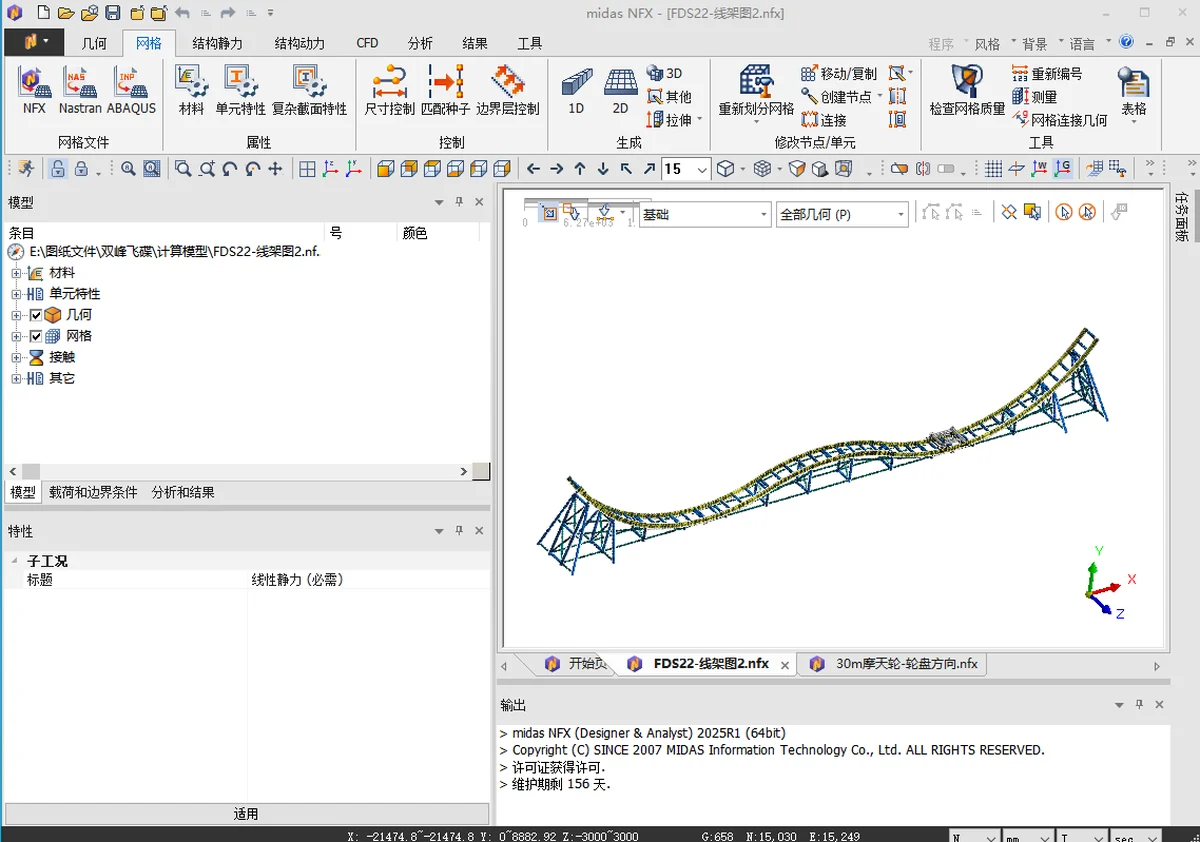
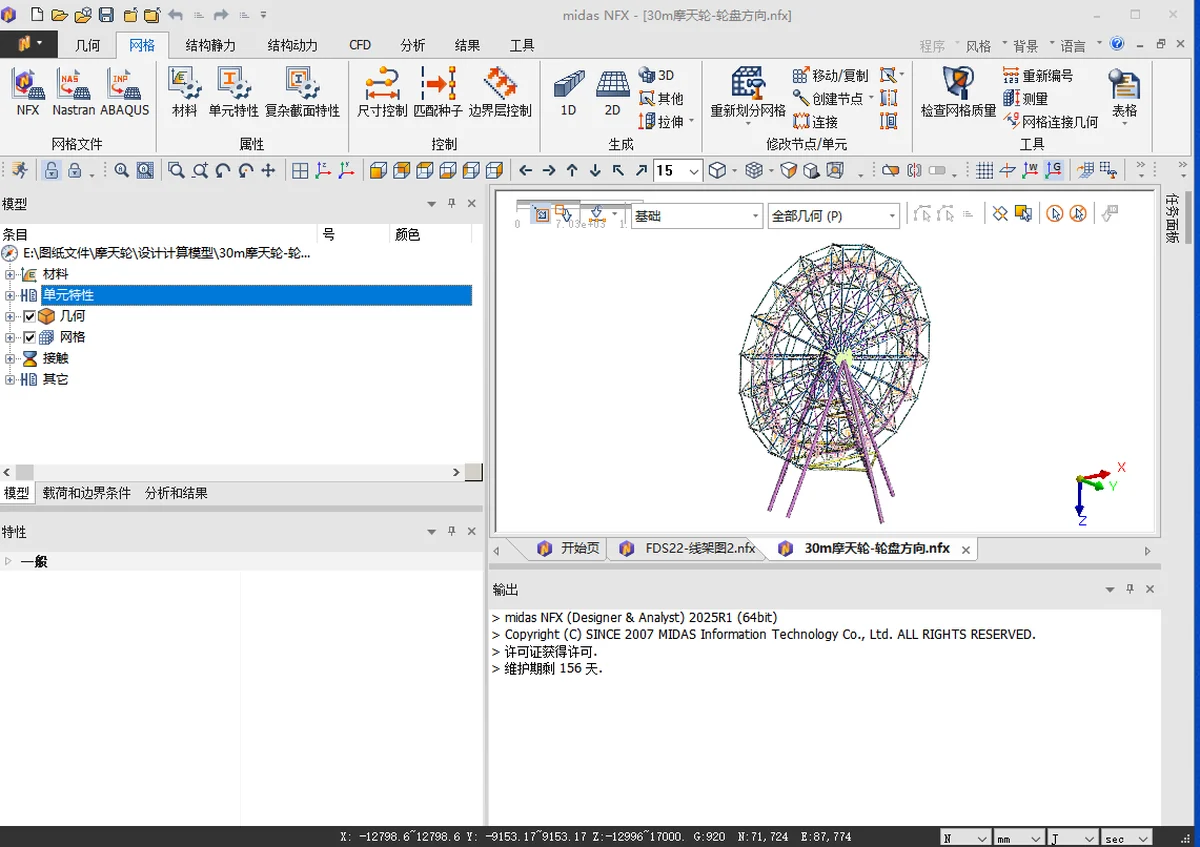
4. Issue the calculation report before manufacturing drawings. The report is reviewed internally before any steel is cut. Changes at this stage cost nothing; changes after fabrication cost a container.
5. Verify the physical article against the same drawings. For export projects, third-party inspection (SGS) can verify materials and welds against the drawings the calculation was based on. The calculation and the inspection refer to the same document — that is the point.
MIDAS is not a niche package. The same software family has been used for structural analysis on projects including Burj Khalifa and the Jeddah Tower, and by engineering firms such as Arup, Ramboll, Samsung C&T and Thornton Tomasetti on towers across Europe and the Middle East. Its overseas project reference book also lists work by Chinese design institutes on plants, water structures and transmission projects in Egypt, Pakistan, the Philippines, Vietnam, Montenegro and Bangladesh.
That is worth noting less as a brand claim and more as a sanity check: if an 828 m tower can be analysed in this package, a 128 m wheel sits comfortably inside its validated range.
What the software does not do is replace engineering judgement. It computes what the model is asked to compute. Somebody still has to choose the load cases, decide which member governs the design, and read the results correctly. That part is ours.
A 128 m observation wheel is a useful example because it sits where the three effects above all matter at once.
At that height, wind load governs the design of the rim and the legs; fatigue governs the cabin hangers and the joints that see a load cycle every revolution; and the structure’s natural frequency has to be checked against the rotation period and against wind-induced vibration.
None of these can be resolved by increasing section sizes until it “looks strong enough”. They can only be resolved by modelling the structure, applying the standard’s load cases, and reading the results.
That is why we list a 128 m wheel as a custom-engineered project rather than a catalogue item. The engineering is the product.
If you are sourcing a large ride, these questions separate suppliers who calculate from suppliers who estimate:
“Can you provide the structural calculation report?” A supplier who does the work will have one. A supplier who does not will offer drawings instead, or say the report is confidential without offering a summary.
“Which load cases did you check, and against which standard?” The answer should name the standard and the load types — dead, live, wind, dynamic. A vague answer about “international standards” usually means no calculation was done.
“What governs the design at this height — strength, fatigue, or stiffness?” For large rides there is a correct answer, and it changes with height and ride type. A supplier who has modelled the structure will know which one controls their design.
“Can the structure be inspected against the calculation drawings?” This is the link between design and delivery. If inspection and calculation refer to different documents, the calculation did not really drive the build.
A large ride is a long-term asset. The purchase price is paid once; the consequences of under-designed structure are paid for over the life of the installation — in inspections, in repairs, and in the worst case, in incidents.
The visible difference between a calculated structure and an estimated one is small on a rendering. It shows up in the calculation report, in the inspection records, and in how confidently the supplier answers the four questions above.
If you are evaluating a Ferris wheel, coaster or observation tower above 50 m, ask for the calculation. We are happy to walk through ours.
→ Request a structural calculation summary (NDA available)
→ See our engineering process
Last updated: 26 October 2026
Zhengzhou Yueton Amusement Equipment Co., Ltd. is a manufacturer of amusement rides and turnkey park solutions, founded in 2016. Exported to 100+ countries, 500+ ride units delivered. Structural design is verified using MIDAS finite element analysis against EN 13814; third-party SGS inspection is available on request.
See the 128 m wheel on our main site: Ferris wheel for sale — yuetonrides.com
Tell us the ride type, site size and target opening date. We reply within one working day.